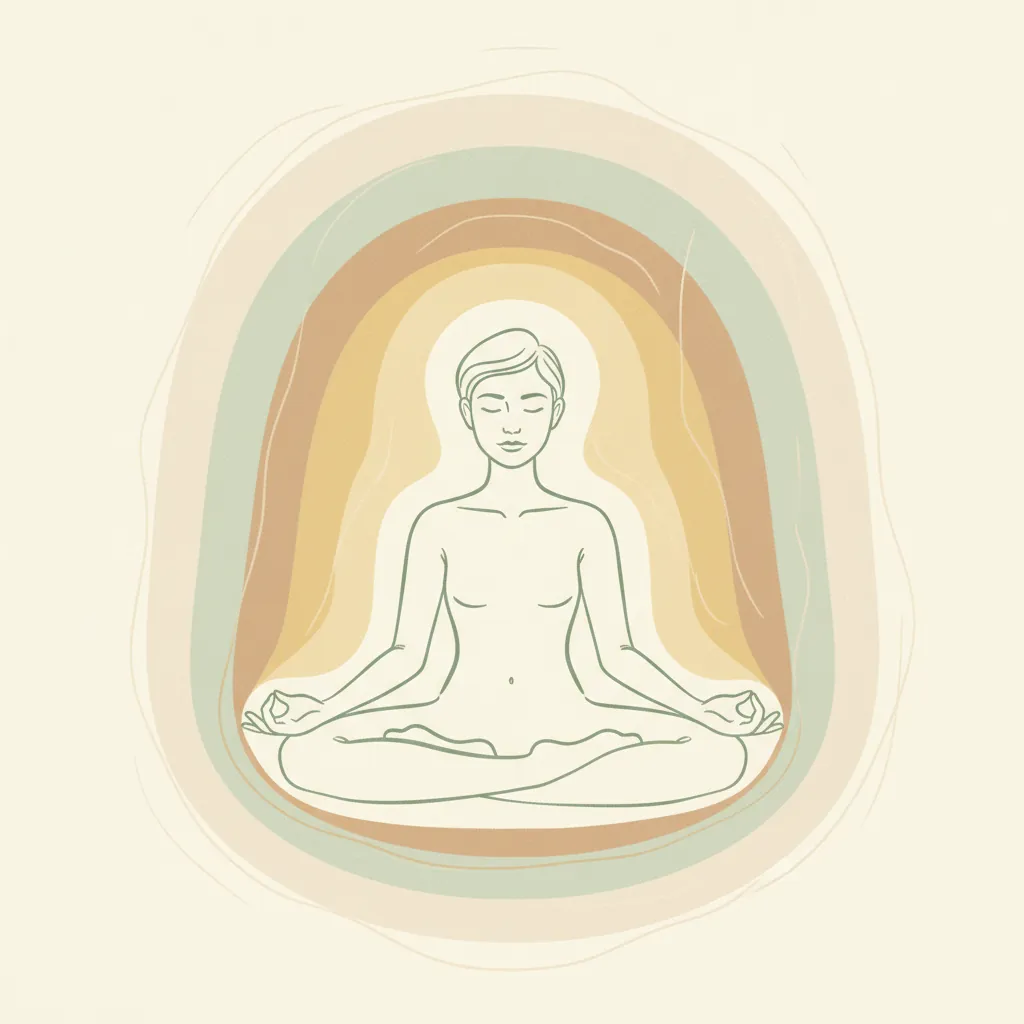
Why can two people with the "same" diagnosis respond so differently to the same treatment? Often it's because their pain is rooted on different levels. Dr. Klinghardt developed the Five Levels of Healing in the 1980s as a way to look at the whole person — and it's the lens I use in every session.
The model isn't entirely new. It draws on an ancient idea from Indian philosophy — the five koshas, or "sheaths," that describe a human being as layers from the physical body outward to the subtlest spirit. Dr. Klinghardt brought that map together with modern neurobiology, creating a framework that many holistic practitioners around the world now use.
The five levels
🌿 Physical — the body's structure and function: alignment, muscles, fascia, nutrition, and detox. This is where structural therapy, movement, and dietary support do their work.
🔋 Energetic — the autonomic nervous system, immune system, and other regulatory systems. Things like electromagnetic fields and geopathic stress affect this level; acupuncture and neural work help settle it.
💭 Mental — thoughts, beliefs, attitudes, and stored experiences. Unresolved stress here can disrupt the flow of energy and nutrients, and approaches such as Mental Field Therapy and Applied Psycho-Neurobiology help release it.
🌌 Intuitive — the collective field and energies that can influence individuals and families. Burdens carried across generations sometimes show up here as illness or dysfunction.
✨ Spiritual — deeply personal, concerning your relationship with the sacred. It isn't something a therapist works on directly, but it quietly shapes our overall sense of wellness.
Each level is more powerful than the one below
One of the most useful ideas in this model is that the levels are arranged in order of influence: each one can shape everything "beneath" it. A belief held on the mental level can drive tension on the physical level; a sense of safety on the energetic level can let a stubborn muscle finally release. This is why working only on the most physical layer sometimes isn't enough — if the real driver sits higher up, the body keeps recreating the same symptom. It also means a shift on a higher level can ripple down and free things that hands alone never could.
Why it matters for your treatment
The levels are deeply interconnected — a block on one can keep showing up as a symptom on another. If we only ever treat the physical layer while the real source sits on the energetic or mental level, relief tends to be short-lived. Looking across all five lets us find where the block truly lives, and meet it there.
Alongside the levels, Dr. Klinghardt points to seven key factors that the body can register as stress — structure, nutrition, toxins, infections, electromagnetic load, blocked energy (such as scars), and unresolved emotions. He maps each factor onto the levels, which is what makes the framework so practical: it turns "treat the whole person" from a nice idea into an actual map. You can read more about both on the home page.
Whole-person healing isn't about doing more — it's about looking in the right place. By caring for every level of who you are, your body can find its way back to balance.
References & further reading
- Klinghardt D. The Five Levels of Healing and the Seven Factors. Klinghardt Academy / Institute of Neurobiology (INK).
- Klinghardt D, Williams D. A Comprehensive Review of Heavy Metal Detoxification and Klinghardt's Five Levels of Healing. Explore Publications.
- On the koshas: Feuerstein G. The Yoga Tradition: Its History, Literature, Philosophy and Practice. Hohm Press; 1998.
For education only, and not medical advice. The Five Levels of Healing is a holistic framework that complements, rather than replaces, conventional medical diagnosis and care.