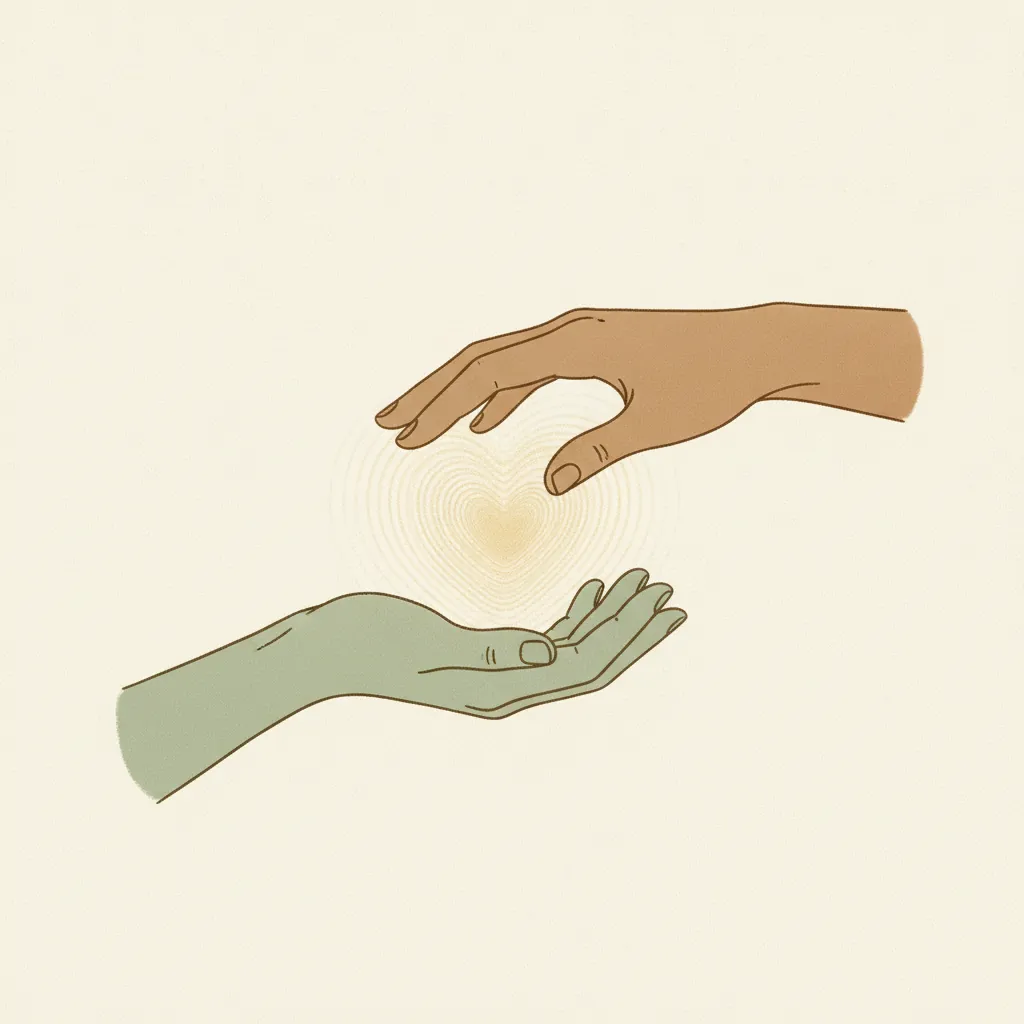
You've probably heard oxytocin called "the love hormone." But that nickname badly undersells it. Oxytocin is a tiny chain of just nine amino acids, yet it plays three roles at once — hormone, neurotransmitter, and neuromodulator — touching everything from childbirth and bonding to how safe you feel sitting in a quiet room. It is one of the body's most important messengers of safety.
It's not just about bonding
Oxytocin isn't only made in the brain. At sites of inflammation, the body can produce it locally as a natural anti-inflammatory — research shows it can dampen the release of pro-inflammatory signals such as TNF-α and IL-6, helping to quieten an overactive immune response. In other words, calm isn't only a feeling; it has a measurable chemistry.
It also reaches deep into the brain's fear centre. In a landmark 2012 study, researchers showed that oxytocin released into the central amygdala activates a local circuit that turns the volume down on fear. This is part of why a sense of safety can arrive in the body before the thinking mind has caught up — the chemistry of reassurance is already at work.
Why touch can heal
Your skin has a dedicated set of nerve fibres — called C-tactile afferents — that respond not to pressure but to slow, gentle, caress-like touch, at roughly the speed and warmth of a human hand. When these fibres are stimulated, they carry a "pleasant touch" signal to the insula, the part of the brain that senses your inner state. The hypothalamus responds by releasing oxytocin, which lowers cortisol, calms the amygdala, and helps modulate pain.
This is why, sometimes, the moment a therapist's hands simply rest on you — before anything is "done" — the body already begins to soften. It's not that a muscle has been pressed open. It's that your nervous system has received a message: you are safe. And that message travels at the level of molecules.
When safety is hard to feel
For some people — especially after trauma, loss, or a long stretch of stress — touch and closeness don't register as soothing straight away. The same nervous system that's meant to relax has learned to stay on guard. If that's you, it isn't a flaw, and it isn't permanent. It simply means we go slowly, let your body set the pace, and build the felt sense of safety one small, unhurried step at a time. Oxytocin responds best when nothing is being forced.
A system you can rebuild
Oxytocin isn't a single switch — it's a system, and it stays changeable throughout life. You can gently strengthen it with everyday things: listening to music you love (singing with others is stronger still), spending time with animals, brief cold exposure, meditation or prayer, warm eye contact, shared meals, and hugs. Each safe connection tells your nervous system the same thing: you can relax now.
A tiny nine-amino-acid peptide helps decide whether your body can move from simply surviving to truly thriving. The good news: you can help it along, one safe connection at a time.
References & further reading
- Knobloch HS, Charlet A, Hoffmann LC, et al. Evoked axonal oxytocin release in the central amygdala attenuates fear response. Neuron. 2012;73(3):553–566.
- McGlone F, Wessberg J, Olausson H. Discriminative and affective touch: sensing and feeling. Neuron. 2014;82(4):737–755.
- Wang P, Wang SC, Liu X, et al. Oxytocin and related peptide hormones: candidate anti-inflammatory therapy in early stages of sepsis. Frontiers in Immunology. 2022;13:864007.
- Uvnäs-Moberg K. The Oxytocin Factor: Tapping the Hormone of Calm, Love, and Healing. Da Capo Press; 2003.
For education only, and based on published neuroscience research. It is not medical advice, and individual responses vary.