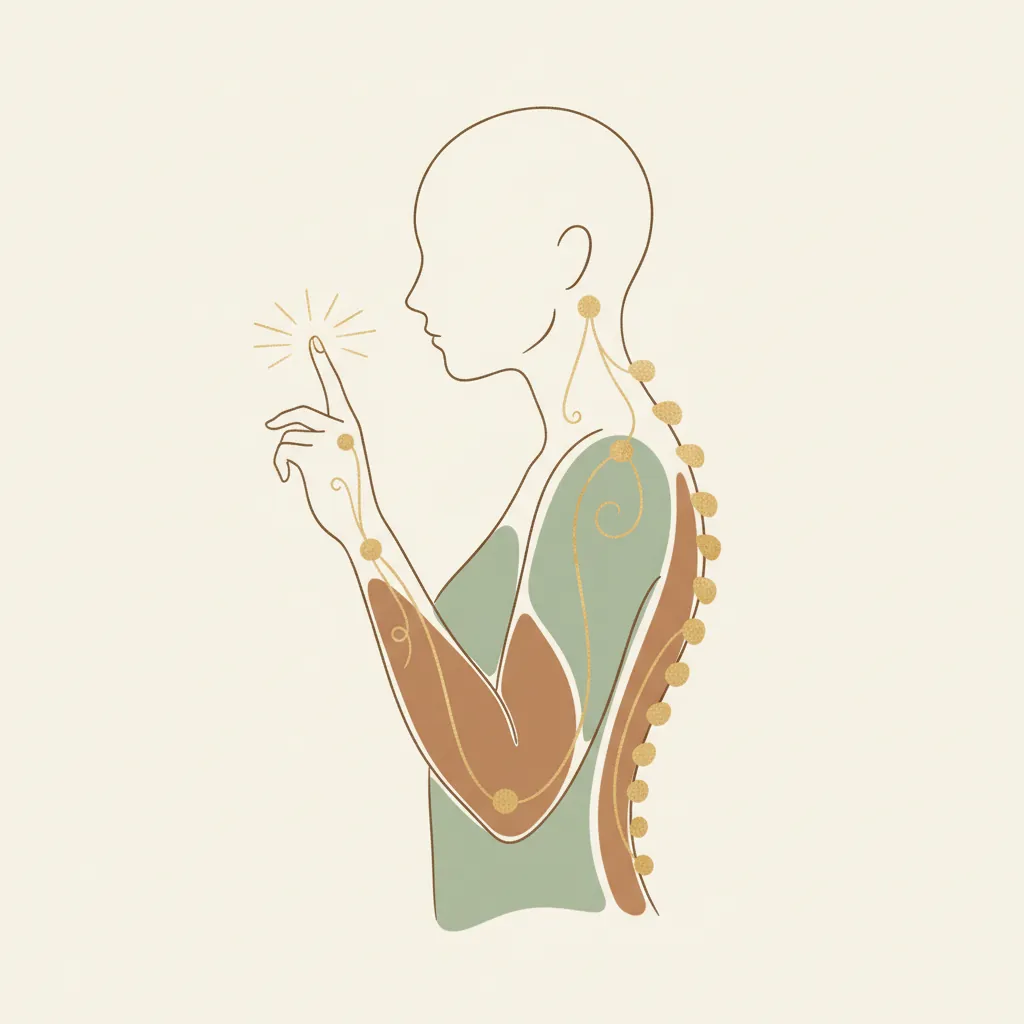
A client came in for right shoulder pain. As we talked, I learned that her left shoulder had been injured years ago, and she'd once sprained her ankle too. The shoulder that hurt today was only the latest chapter of a much longer story.
The body's story often hides beyond "the part that hurts."
Pull one hair, and the whole body moves
Another client jammed a little finger, and the pain lingered for almost two months. It turned out the finger wasn't really the problem — it was connected to a curve in the spine, and even to tension showing up in the arm and the gut. One small injury had quietly reorganized how the whole body was holding itself.
Why this happens
Your body is not a collection of separate parts. Fascia — the continuous web of connective tissue that wraps every muscle, bone, and organ — links you together from head to toe. The bodywork teacher Thomas Myers mapped these long lines of pull as "myofascial meridians," and they explain how a fallen arch in the foot can pull on the lower back, or how a tight jaw can tug at the neck and shoulder. Strain travels along the webbing, sometimes a surprising distance from where it began.
There's a second reason, too. Many nerves from different parts of the body funnel into the same junctions in the spinal cord, so the brain can struggle to pinpoint exactly where a signal came from. This is "referred pain" — the reason a heart problem can be felt in the left arm, or an irritated neck nerve can show up as a burning hand. When you add in the nervous system's habit of tightening one area to protect another, it's easy to see why the spot that finally calls out is often not the source.
Emotions can be held in the body too, adding another layer to the picture — a tension that no amount of stretching quite resolves, because it's holding more than muscle.
Looking for the root, not just the symptom
This is why I assess the whole body rather than only the spot that hurts — through structural evaluation, autonomic response testing, and careful listening to your history. Often the most useful question isn't "where does it hurt?" but "what happened before it started hurting?" An old ankle sprain, a long-forgotten fall, a surgery, a season of stress — these are the threads that lead back to the root. The goal isn't to chase the pain around the body, but to find where it truly lives and help the whole system return to balance.
If a pain keeps returning even after you've treated it "right at the spot," it may be time to step back and look at the bigger picture.
References & further reading
- Myers TW. Anatomy Trains: Myofascial Meridians for Manual and Movement Therapists. 4th ed. Edinburgh: Elsevier; 2021.
- Schleip R, Findley TW, Chaitow L, Huijing PA, eds. Fascia: The Tensional Network of the Human Body. Edinburgh: Churchill Livingstone / Elsevier; 2012.
- Bordoni B, Escher AR. The importance of the posterior thoracic fascia and myofascial chains. Cureus. 2020 (review of myofascial chains and referred strain).
For education only, and not medical advice. Some referred pain can signal a medical condition that needs prompt attention — if pain is severe, sudden, or unusual for you, please see a doctor.